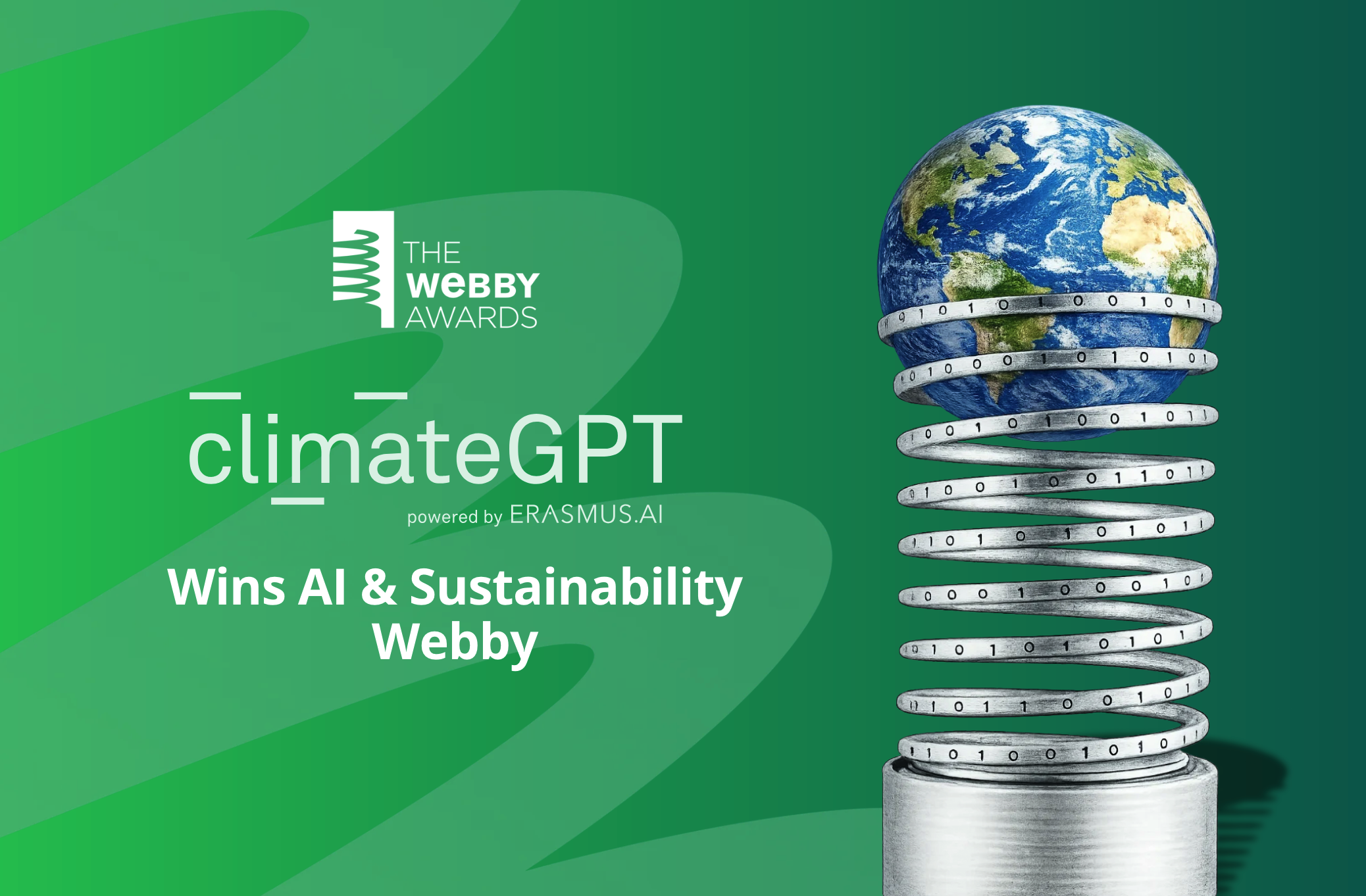
ClimateGPT has won the Webby Award in the AI: Energy and Sustainability. At the 30th Annual Webby Awards, often called the “Internet’s highest honour”, ClimateGPT took the award in the AI: Energy and Sustainability category, selected from more than 13,000 entries across all categories this year. Only the top 11% of projects reached the nomination stage. The International Academy of Digital Arts and Sciences recognises that public good, open, climate intelligence belongs at the forefront of the AI revolution.
What the Webby Award Means
The Webby Awards have recognised excellence on the Internet since 1997. Judged by the International Academy of Digital Arts and Sciences — whose members include leaders from across technology, media, and culture — a Webby win signals that a project represents the best of what the Internet could be.
For ClimateGPT, this award is more than a trophy. It is a validation of the principle that Climate AI does not need to be large, energy intensive, proprietary, nor optimised for engagement over accuracy. In a landscape with large black-box AI systems ClimateGPT makes a case for public good AI. The Webby judges recognised that difference.
Why ClimateGPT Is Different
Most AI tools treat climate as one topic among thousands. ClimateGPT was purpose-built to synthesise and humanise interdisciplinary research on climate change.
Built by Erasmus.AI, and released by the Foundation, ClimateGPT in partnership with Club of Rome’s Earth4All is an open-source family of large language models trained on web-scale corpora, Club of Rome‘s research, International development organizations, treaty organizations, and the broad NGO community (World Bank, OECD, IPPC, UN, EU, TCFD, US Gov, Nation State Governments, NASA, ESA, WRI, IREA, WEF, Nature Finance,etc.) together publish significant well-researched work on climate change and its impacts on financial systems, countries, ecologies, etc and is free to use for researchers worldwide.
That openness is a deliberate design choice. A researcher in Nairobi can access the same climate intelligence as a policymaker in Brussels. Users range from individual practitioners, policy makers, researchers to institutions. The published benchmarks show ten times the efficiency on climate-specific tasks compared to general-purpose models, 12x less CO2. An achievement which ClimateGPT 2, and ClimateGPT 3, launched respectively in January 2025, and 2026 in Davos, equalled. Crucially, ClimateGPT was trained and is hosted on renewable energy and published its sustainability scorecard in its launching paper.
A Vote of Confidence from the Global Community
The Webby nomination itself placed ClimateGPT alongside some of the most well-resourced AI projects in the world. That a purpose-built, open-source climate model earned this recognition speaks to a growing consensus: the AI does always have to be the biggest or the most expensive. Our long term public interest is the .
We are grateful to Internet Archive Europe, whose support has been instrumental in advancing ClimateGPT’s mission of universal access to climate knowledge. We are grateful to the researchers, policymakers, educators, and climate professionals who use ClimateGPT every day and whose feedback makes it better. And we are grateful to everyone who voted and championed this project through the nomination process.
What Comes Next
This award arrives at a critical moment. Climate disinformation continues to shape legislation, investment decisions, and public understanding of risk. The need for AI that is transparent, grounded in peer-reviewed science, and designed to counter misinformation rather than amplify it has never been greater.
ClimateGPT will continue to evolve —3.5 is due to be releases shortly, and then a focus on deeper regional capabilities, integration of emissions information, expanded domain coverage, and stronger tools for adaptation planning & climate finance. The Webby Award is not the destination, it is support that we are on the right path.
Explore ClimateGPT at climategpt.ai and join the community building AI for the climate transition.
ClimateGPT is developed by Erasmus.AI with support from Internet Archive Europe.
Leave a Reply