ClimateGPT Overview
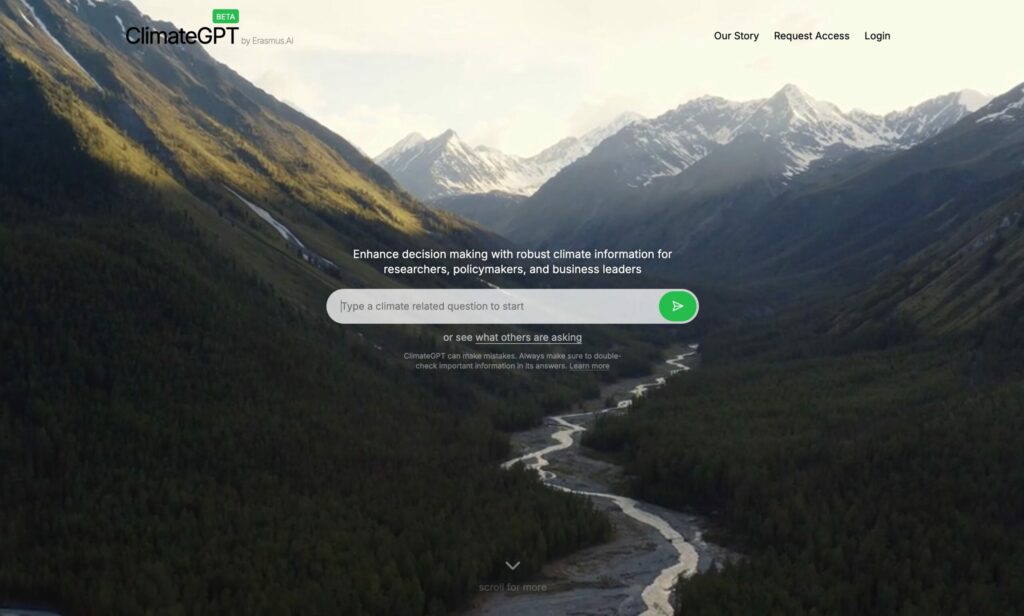
ClimateGPT is a pioneering undertaking to use AI to accelerate humanity’s reaction to its greatest challenge- climate change. It is not just an Artificial Intelligence endeavour it is a Social Intelligence intervention– how do we get better at understanding, anticipating & responding to changing climate. We do this by creating open source open access, democratised, Public Good AI model family and suite of services for a prepared, resilient and sustainable future.
Developed in partnership with the Club of Rome and the Earth4All, a 50 year review of the seminal The Limits to Growth study. The team, a global North-South collaboration released the first model in COP28 , and open sourced the family at Davos in Jan ’24. This was followed up by ClimateGPT 2 in Davos, Jan ’25, ClimateGPT 2.5 in 2025. ClimateGPT 3.0 focussed on Planetary Boundaries was released together with Johan Rockström in Davos in Jan 2026.
The initial model was released 50+1 years after the seminal Limits to Growth work, exploiting the 35 doubling of computational capability to compliment Earth4All work
We aim to democratise access to high-quality climate information through open-source, open access, low energy consuming public good AI language models. The models are augmented by ~3M climate facts as RAG references.
For each iteration we build ~200 internal models for benchmarking, testing, etc, and have maintained a yearly release schedule of numbered models. The model family include both foundational/frontier models trained from scratch and fine-tuned models. Currently the development community comprise just over 25 000 downloads on Huggingface, including a number of University partnerships. With each public release we have maintained a 10x reduction in model size for equivalent query performance.
What distinguishes ClimateGPT from general-purpose AI systems is its deliberate focus on human implications of climate change rather than meteorological modelling, building upon the Club of Rome’s Earth4All framework and incorporating comprehensive body scientific research.
ClimateGPT Model 1: Establishing the Foundation
Released at COP28 in December 2023 and open sourced at Davos 2024, ClimateGPT Model 1, the first foundational language model specifically built for climate change—the second foundational model to emerge from the EU after Mistral, and notably the first AI model partially built in Africa. This initial release challenged assumptions about the trade-offs between model size, performance, and environmental impact.
 |  |  |  |  |
| The first open-source AI platform dedicated to addressing the impact of climate change … ClimateGPT is a decision-making and research support tool that tries to bring a deeper understanding of the novel interconnections that climate disruptions will create | ClimateGPT, a custom-built generative AI chatbot developed by Erasmus.ai ..by applying AI to meet the greatest existential threat facing humanity, AI can perhaps be absolved of itself being the greatest existential threat to humanity. | Policymakers, business leaders, and researchers are expected to benefit from the decision support provided by ClimateGPT, helping them make informed decisions in the face of uncertainty. | ClimateGPT, a new AI tool for researchers, policymakers and business leaders, allows users to pose questions about climate change and trace the data sources for responses. | ClimateGPT aims to create “trust and transparency” by drawing on scientific data using a robust model that authenticates, secures, and governs the information provided. |
| Using AI for a deeper understanding of climate disruption | AI’s killer app: Guiding humanity through the climate challenge | ClimateGPT emerges as AI tool against climate disinformation | In Davos, divided optimism about AI | Meet ClimateGPT — an open source AI platform fighting climate disinformation |
The breakthrough came in efficiency and sustainability. ClimateGPT Model 1 demonstrated that curated, domain-specific approach could achieve comparable results to models whilst using fewer resources. The model consumed 12 times less CO2 per query compared to standard models of equivalent quality, which was achieved through models that were 10 times smaller than their conventional counterparts. This wasn’t merely an incremental improvement—it represented a fundamental rethinking of how AI models could be trained, how models can democratise AI and be deployed for specialised domains.
Key technical achievements included:
- Training on 300B+ tokens with 4.2B domain-specific climate tokens
- Foundational Model with from-scratch training variants (FSC and FSG) to compare different training approaches
- Multiple variants: 7B, 13B, and 70B parameter models using continued pre-training from Llama 2
- 270K instruction fine-tuning dataset using a set of breakthrough fact based approaches.
The model’s foundation rested on curated datasets spanning extreme weather events (over 1 million articles per year across a decade), technical breakthroughs in energy and climate technology, UN ‘s 17 SDG’s Sustainable Development Goals tracking, climate academic research, and comprehensive institutional publications including IPCC reports, NASA, World Resources Institute, OECD, World Bank, ESA. etc. This diverse corpus enabled the model to understand climate change not as an isolated meteorological phenomenon but as an interconnected system affecting human societies across multiple dimensions.
Perhaps most significantly, ClimateGPT Model 1 was the first AI model to be entirely trained and operated on renewable energy, specifically hydropower, with the first complete sustainability scorecard published in the model release paper. It achieved a self reported Foundation Model Transparency Index (FMTI) score of 62, exceeding Llama 2’s score and setting a new standard for responsible AI development in the climate space.
The model’s performance validated the approach: ClimateGPT-7B matched the capabilities of Llama-2-70B Chat on climate-specific benchmarks despite being ten times smaller, whilst maintaining strong performance on general domain tasks. This demonstrated that specialised domain adaptation with carefully curated data could achieve expert-level performance without requiring massive energy intensive computational resources.
ClimateGPT Model 2: Scaling Knowledge and Quality
Released at Goals House in Davos in January 2025, ClimateGPT 2 represented a substantial evolution rather than a simple iteration. The development team had learnt from the first model’s deployment and user feedback, leading to strategic improvements that doubled the climate training set and increased the quality and quantity of training questions by an order of magnitude.
The second generation processed over 50 billion articles through enhanced curation pipelines, resulting in approximately 8-10 billion climate-specific training tokens—double the original dataset. This expansion built on more sophisticated filtering and quality control mechanisms to ensure that additional tokens contributed meaningfully to the model’s knowledge base.
Model 2’s improvements included:
- Integration of 3 million climate facts as structured references
- Development and testing of over 200 model variants during the training process in 2024
- Enhanced retrieval augmented generation with hierarchical retrieval strategies
- Improved multi-dimensional response capabilities across natural science, economic, and social perspectives
By the time of its release, the model had attracted significant attention from the developer and research community, with over 15,000 downloads on HuggingFace and sponsored access provided to well over 1,000 researchers from institutions including NASA and ESA. The model maintained its commitment to efficiency, continuing to operate as a model 10 times smaller than standard equivalents whilst achieving comparable or superior performance on domain-specific tasks.
The instruction fine-tuning process became more sophisticated, incorporating expanded datasets from both climate experts and trained non-expert annotators. This hybrid approach ensured both scientific accuracy and practical usability, as the model learnt to communicate complex climate concepts in accessible language whilst maintaining technical precision when needed.
ClimateGPT Model 2.5: Integrating Quantitative Data
Model 2.5 emerged as a strategic intermediate release, bridging the gap between Model 2’s enhanced knowledge base and Model 3’s specialised focus on Planetary Boundaries. The primary innovation in this version was the integration of massive-scale emissions datasets, specifically incorporating Climate Trace data containing approximately 500 million data points.
This quantitative leap transformed the model’s capabilities in a fundamental way. Rather than only discussing emissions conceptually or in aggregate terms, Model 2.5 could now provide specific, facility-level information about emissions sources worldwide. Users could query the model about emissions from particular airports, industrial facilities, or geographic regions and receive precise, data-backed responses including information about facility ownership, location, and temporal trends.
The technical foundation for this release drew on sophisticated domain adaptation techniques. The team developed a novel context-gated filtering framework that achieved remarkable precision in data curation—85.4% precision whilst maintaining 88.3% recall. This filtering approach addressed a fundamental challenge in domain-specific AI: how to extract relevant information from massive web corpora when technical terminology often has ambiguous meanings in general contexts.
The two-phase training approach refined the model systematically:
Phase 1: Continued pretraining on 11.2 billion curated climate tokens
Phase 2: Supervised fine-tuning on 50,000 instruction-response pairs spanning climate-specific Q&A, general instruction following, safety protocols, multi-turn dialogues, and tool use
The team processed 10.4 terabytes of web text to produce this high-quality training corpus, implementing hash-based deterministic sampling and topic-balanced stratified sampling to ensure reproducibility and diverse representation. This approach to data quality proved more effective than simply training on larger volumes of less-refined data, aligning with emerging research emphasising quality over quantity in language model training.
ClimateGPT Model 3: Planetary Boundaries Specialisation
Released in collaboration with Johan Rockström from the Potsdam Institute for Climate Impact Research at Goals House in Davos in January 2025, Model 3 focused intensively on the Planetary Boundaries framework—a rigorous approach to defining a safe operating space for humanity by identifying nine critical Earth system processes.
The planetary boundaries framework provides a comprehensive lens for understanding Earth system stability, encompassing climate change, biosphere integrity, land-system change, freshwater change, biogeochemical flows of nitrogen and phosphorus, ocean acidification, atmospheric aerosols, stratospheric ozone depletion, and novel entities including chemical pollution. Understanding these interconnected systems requires not just factual knowledge but the ability to reason about multi-scale interactions, feedback mechanisms, and threshold effects that could trigger irreversible changes.
Model 3 was trained on approximately 50 billion planetary boundaries-specific tokens, with custom supervised fine-tuning pipelines designed to create “gold standard” training data focused on these nine boundaries. The collaboration with PIK Potsdam ensured that the model’s understanding aligned with current scientific research on Earth system processes and tipping points.
To properly evaluate this specialised knowledge, the team developed a comprehensive Planetary Boundaries Evaluation Suite containing over 500 manually curated questions distributed across the nine boundary categories. The evaluation protocol included both multiple-choice and short-answer formats with strict answer normalisation to handle the diversity of valid scientific expressions. The results demonstrated substantial improvements: Model 3 achieved an 18.6 percentage point improvement on planetary boundaries multiple-choice questions compared to instruction-tuned baseline models, whilst maintaining general capabilities with only minimal degradation (0.6% on MMLU benchmarks).
This performance validated a key hypothesis: that targeted domain adaptation with carefully curated data could create expertise in specialised scientific domains without sacrificing general reasoning. The model showed particular strength in understanding the interdependencies between boundaries—for instance, how land-system changes affect both biosphere integrity and biogeochemical flows, or how climate change interacts with ocean acidification.
Model 3 continued the project’s commitment to sustainability, again achieving a 10x reduction in CO2 usage compared to equivalent general-purpose models. This meant that organisations and researchers could deploy powerful climate-focused AI capabilities with a fraction of the energy and environmental footprint typically associated with large language models.
Progressive Evolution and Cross-Version Insights
The evolution from Model 1 through Model 3 reveals a strategic progression in both technical capabilities and domain specialisation. Model 1 established the foundational approach and proved that domain-specific training could achieve efficiency gains without sacrificing performance. It demonstrated that careful data curation and focused training objectives could produce models that punched well above their weight class in terms of parameter count.
Model 2 built on this foundation by substantially expanding the knowledge base and refining the quality of training data. The doubling of the climate training set and 10x improvement in question quality reflected lessons learnt from real-world deployment. Users needed not just accurate information but nuanced understanding of complex interactions and the ability to view climate challenges from multiple disciplinary perspectives—natural science, economics, and social dimensions.
Model 2.5’s integration of massive-scale quantitative emissions data addressed a specific gap: the ability to ground discussions in concrete, facility-level data rather than abstract aggregates. This made the model more practical for policy analysis, corporate sustainability planning, and accountability mechanisms. The technical innovations in context-gated filtering developed for this release proved valuable beyond the immediate application, offering a methodology for extracting high-precision domain-specific data from noisy web corpora.
Model 3’s specialisation in planetary boundaries represented a culmination of these progressive improvements whilst also pointing towards new possibilities. By focusing on the comprehensive framework of Earth system processes, it created a model capable of reasoning about the interconnected nature of environmental challenges. The collaboration with leading research institutions like PIK Potsdam ensured scientific rigour whilst the custom evaluation suite provided reliable metrics for assessing genuine domain expertise rather than surface-level pattern matching.
Common threads across all versions include:
- Transformer-based decoder-only architecture building on proven foundations
- Retrieval Augmented Generation (RAG) with curated climate document databases
- Multi-dimensional response capabilities addressing different disciplinary perspectives
- Open source, open access availability for public good AI promoting transparency and accessibility
- Training exclusively on renewable energy with published sustainability metrics
Impact and Community Adoption
The ClimateGPT project has achieved substantial real-world adoption, with over 25,000 technical developer downloads on HuggingFace and integration into research and educational programmes at leading universities including George Mason University, Georgetown University, etc. The models have contributed to practical applications ranging from policy development in countries like Sri Lanka and Ghana to supporting Climate research development and serving as educational tools for climate science courses.
The project’s business model balances accessibility with sustainability: maintaining free access for academic and research use whilst generating revenue from grants and enterprise applications, particularly in financial services for modelling medium and long-term climate risk. This approach ensures that the models remain public goods whilst supporting continued development and improvement.
The efficiency gains achieved across all model versions have significant implications beyond the immediate application. By demonstrating that 10x smaller models trained on curated data can match or exceed the domain-specific performance of much larger general-purpose models whilst using 12x less energy per query, ClimateGPT provides a template for sustainable AI development in other specialised domains. This challenges the prevailing assumption that AI progress requires ever-larger models with corresponding environmental costs.
As the project continues to evolve, planned developments include ClimateGPT 3.5, 4.0+ with integration of Earth Observation datasets, expansion of the extreme weather events database